
A cooktop is one of the most frequently used appliances in a kitchen, so choosing the right configuration can have a noticeable effect on everyday cooking. Gas stove tops use gas burners to provide direct, visible heat and allow cooks to adjust the flame quickly.
Unlike a full range, a gas cooktop is generally installed directly into the countertop without an oven underneath. This configuration can provide greater flexibility because the oven can be installed separately, including in a wall-mounted position.
Gas cooktops are available in different widths, burner arrangements, materials, ignition systems, and heat outputs. The right choice depends on the available counter space, cooking habits, household size, fuel supply, ventilation, and preferred kitchen design.
How Do Gas Stove Tops Differ From Ranges?
The main difference is that a gas cooktop provides the cooking surface only, while a traditional range combines a cooktop and oven in one appliance.
This distinction can be important during a kitchen renovation. A homeowner who wants an integrated countertop cooking surface with a separate wall oven may prefer a cooktop, while someone looking for a single appliance may find a range more practical.
Separating the cooktop and oven can also provide flexibility in kitchen layout. For example, the oven can be installed at a more convenient height instead of requiring users to bend down to access it.
How Many Burners Do You Need?
Burner count should be based on how you actually cook rather than simply choosing the largest available model.
A two- or three-burner configuration may be adequate for compact kitchens or households that prepare simple meals. Four burners are a common choice for everyday cooking, while five-burner models can provide additional flexibility for households that regularly use several pots and pans at once. Bosch similarly recommends considering kitchen space, cooking habits, and household size when selecting burner quantity.
Spacing is just as important as burner count. A cooktop with five burners may not be particularly useful if large cookware cannot fit comfortably without interfering with neighboring burners.
What Is BTU and Why Does It Matter?
BTU, or British Thermal Unit, is commonly used to describe the heat output of gas burners. Higher-output burners can provide the intense heat needed for tasks such as searing, wok cooking, or rapidly boiling large amounts of water.
Lower-output burners are useful for gentler cooking techniques such as simmering sauces or melting delicate ingredients. A well-designed cooktop should therefore offer a range of burner outputs rather than maximizing every burner.
Current gas-cooktop buying guidance commonly identifies standard burners in the approximately 8,000–12,000 BTU range, with higher-output burners reaching 12,000–18,000 BTU or more on some models.
The most useful configuration depends on your cooking style. If you rarely use high heat, an extremely powerful burner may offer little practical advantage.
Should You Choose Sealed or Open Burners?
Gas cooktops can use sealed or open burner designs.
Sealed burners have a cap between the burner and the cookware. This design can help contain spills and simplify cleaning around the burner assembly.
Open burners allow the flame to rise more directly toward the cookware and are more commonly associated with commercial-style cooking equipment.
For most residential kitchens, sealed burners can be a practical option because everyday cooking inevitably produces spills and splashes.
What Materials Are Available?
Stainless Steel
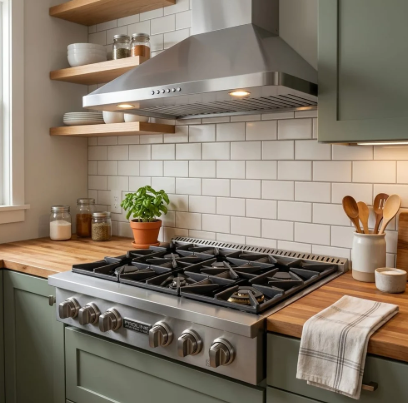
Stainless steel stove tops are popular because the material has a durable, professional appearance and can work well with many kitchen designs. Stainless steel can be particularly suitable for households that expect frequent cooking.
However, it can show fingerprints, grease, and scratches, so proper cleaning is important.
Glass
Glass cooktops can provide a sleek contemporary appearance and are generally easy to wipe down. They may require more care to prevent scratches or surface damage.
Cast-Iron Components
Cast iron is frequently used for pan supports or grates because it provides a stable surface for cookware. Continuous cast-iron grates can allow heavy pots to be moved between burners without lifting them completely.
What Type of Ignition Should You Choose?
Gas cooktops may use manual or electronic ignition, depending on the model.
Manual systems require a separate ignition source, while electronic systems can ignite the burner through the appliance's controls.
Electronic ignition can add convenience, particularly for households that use the cooktop frequently. Regardless of ignition type, the appliance should be installed and maintained according to the manufacturer's requirements.
How Important Is Ventilation?
Ventilation is an important part of planning gas stove tops. Cooking produces steam, smoke, grease, and heat, while gas combustion also produces combustion byproducts.
The American Public Gas Association recommends exhaust ventilation for gas and electric cooking appliances to help remove normal cooking byproducts.
A hood or other suitable exhaust system should be planned alongside the cooktop. The ventilation configuration may depend on the kitchen layout, whether ducting to the exterior is possible, and the requirements of the selected appliance.
For an island installation, downdraft ventilation may be another option where appropriate.
What Size Gas Cooktop Should You Choose?
Available counter space should be the starting point.
Before buying, measure the countertop cutout rather than simply measuring the entire counter. Width, depth, clearances, electrical connections, gas connections, and ventilation space can all affect installation.
The number of burners should also correspond with the available surface area. A larger cooktop can provide greater cooking flexibility, but it can reduce valuable preparation space if the kitchen is compact.
For replacement projects, compare the existing cutout dimensions with the new manufacturer's installation specifications before ordering.
What Safety Features Should You Look For?
Gas appliances should be installed according to applicable requirements and manufacturer instructions. A qualified professional should handle gas connections and other specialized installation work.
One useful safety feature is flame-failure detection. This system can automatically shut off the gas supply if the flame is accidentally extinguished, depending on the appliance.
Other considerations include stable pan supports, appropriately positioned controls, automatic ignition, and clearances around the cooktop.
If you smell gas, do not attempt to operate the appliance or electrical switches. Follow the emergency procedures provided by your gas supplier and appliance manufacturer.
What Should You Consider Before Buying?
A practical checklist can make comparing stove tops easier:
Measure the countertop cutout.
Determine the number of burners required.
Compare burner sizes and BTU outputs.
Consider sealed versus open burners.
Check grate construction.
Choose a suitable surface material.
Review ignition options.
Confirm gas compatibility.
Check ventilation requirements.
Review safety features.
Consider cleaning and maintenance.
Verify installation clearances.
Looking at these factors together is more useful than choosing an appliance based on appearance or maximum burner output alone.
Are Stainless Steel Stove Tops Easy to Maintain?
Stainless steel is relatively durable, but regular maintenance is still necessary. Food residue, grease, and water spots should be cleaned according to the manufacturer's instructions.
Burner caps and grates may need to be removed periodically for more thorough cleaning. Continuous grates can be convenient for moving cookware but may be heavier and more cumbersome to remove.
Avoid abrasive cleaning materials unless specifically approved by the manufacturer because they can scratch stainless-steel surfaces.
What Common Mistakes Should You Avoid?
Choosing Too Many Burners
More burners are not always better if they leave insufficient room for cookware or preparation space.
Focusing Only on Maximum BTU
High heat is useful, but low-temperature control is equally important for everyday cooking.
Ignoring the Countertop Cutout
Always verify the exact installation dimensions before ordering.
Forgetting Ventilation
Plan the cooktop and exhaust system together.
Choosing Based Only on Appearance
The finish matters, but burner configuration, performance, safety, and maintenance are equally important.
How Can You Choose the Right Gas Stove Top?
Start by measuring the available countertop space and identifying the required cutout dimensions. Then determine how many burners you realistically use and whether you need a high-output burner for techniques such as searing or wok cooking.
Next, compare burner layouts, grate construction, surface materials, ignition systems, safety features, and ventilation requirements.
Finally, consider long-term maintenance and installation costs. A cooktop that fits the kitchen correctly and matches your cooking habits can provide greater value than a larger model with features you rarely use.
Conclusion
Gas stove tops provide direct flame control and flexible cooking options without requiring an integrated oven. Choosing the right model involves considering burner count, spacing, BTU range, surface material, grate design, ignition, ventilation, safety, and countertop dimensions. For homeowners who prioritize durability and a professional appearance, stainless steel stove tops can be a practical option, particularly in kitchens where the cooking surface is used frequently. When comparing different stove tops, focus on how the appliance will function in your actual kitchen rather than selecting solely according to appearance or maximum power. Careful measurements, appropriate ventilation, suitable burner configuration, and proper installation can help create a cooking area that is both efficient and practical.


Write a comment ...